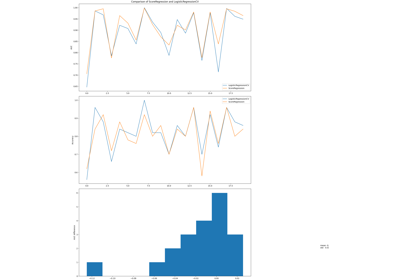
score_regression.ScoreRegression
- class score_regression.ScoreRegression[source]
ScoreRegression classifier
ScoreRegression fits a linear model with coefficients w = (w1, …, wp) to maximize the AUC of the targets predicted by the linear function.
Notes
The feature matrix must be centered at 0. This can be accomplished with sklearn.preprocessing.StandardScaler, or similar. No intercept is calculated.
Examples
>>> import numpy
>>> from calfcv import Calf
>>> from sklearn.datasets import make_classification as mc
>>> X, y = mc(n_features=2, n_redundant=0, n_informative=2, n_clusters_per_class=1, random_state=42)
>>> numpy.round(X[0:3, :], 2)
array([[ 1.23, -0.76],
       [ 0.7 , -1.38],
       [ 2.55,  2.5 ]])
>>> y[0:3]
array([0, 0, 1])
>>> cls = ScoreRegression().fit(X, y)
>>> cls.score(X, y)
0.7
>>> cls.best_coef_
[1, 1]
>>> numpy.round(cls.best_score_, 2)
0.82
>>> cls.fit_time_ > 0
True
>>> cls.predict(np.array([[3, 5]]))
array([0])
>>> cls.predict_proba(np.array([[3, 5]]))
array([[1., 0.]])
- Attributes:
- coef_array of shape (n_features, )
Estimated coefficients for the linear fit problem. Only one target should be passed, and this is a 1D array of length n_features.
- auc_float
The score of the best estimator.
- columns_array of shape (<= n_features, )
The feature indices that contribute to a positive increase in auc.
- n_features_in_int
Number of features seen during fit.
- classes_list
The unique class labels
- fit_time_float
The number of seconds to fit X to y
- decision_function(X)[source]
Identify confidence scores for the samples
- Parameters:
- Xarray-like, shape (n_samples, n_features)
The training input features and samples
- Returns:
- y_dthe decision vector (n_samples)
- fit(X, y)[source]
Fit the model according to the given training data.
- Parameters:
- X{array-like, sparse matrix} of shape (n_samples, n_features)
Training vector, where n_samples is the number of samples and n_features is the number of features.
- yarray-like of shape (n_samples,)
Target vector relative to X.
- Returns:
- self
Fitted estimator.
- fit_transform(X, y)[source]
Fit to the data, then reduce X to the features that contribute positive AUC.
- Parameters:
- Xarray-like, shape (n_samples, n_features)
The training input features and samples
- yarray-like of shape (n_samples,)
Target vector relative to X.
- Returns:
- X_rarray of shape [n_samples, n_selected_features]
The input samples with only the selected features.
- predict(X)[source]
Predict class labels for samples in X.
- Parameters:
- X{array-like, sparse matrix} of shape (n_samples, n_features)
The data matrix for which we want to get the predictions.
- Returns:
- y_predndarray of shape (n_samples,)
Vector containing the class labels for each sample.
- predict_proba(X)[source]
Probability estimates for samples in X.
- Parameters:
- Xarray-like of shape (n_samples, n_features)
Vector to be scored, where n_samples is the number of samples and n_features is the number of features.
- Returns:
- Tarray-like of shape (n_samples, n_classes)
Returns the probability of the sample for each class in the model, where classes are ordered as they are in self.classes_.
- set_score_request(*, sample_weight: bool | None | str = '$UNCHANGED$') ScoreRegression
Request metadata passed to the
scoremethod.Note that this method is only relevant if
enable_metadata_routing=True(seesklearn.set_config()). Please see User Guide on how the routing mechanism works.The options for each parameter are:
True: metadata is requested, and passed toscoreif provided. The request is ignored if metadata is not provided.False: metadata is not requested and the meta-estimator will not pass it toscore.None: metadata is not requested, and the meta-estimator will raise an error if the user provides it.str: metadata should be passed to the meta-estimator with this given alias instead of the original name.
The default (
sklearn.utils.metadata_routing.UNCHANGED) retains the existing request. This allows you to change the request for some parameters and not others.New in version 1.3.
Note
This method is only relevant if this estimator is used as a sub-estimator of a meta-estimator, e.g. used inside a
pipeline.Pipeline. Otherwise it has no effect.- Parameters:
- sample_weightstr, True, False, or None, default=sklearn.utils.metadata_routing.UNCHANGED
Metadata routing for
sample_weightparameter inscore.
- Returns:
- selfobject
The updated object.